

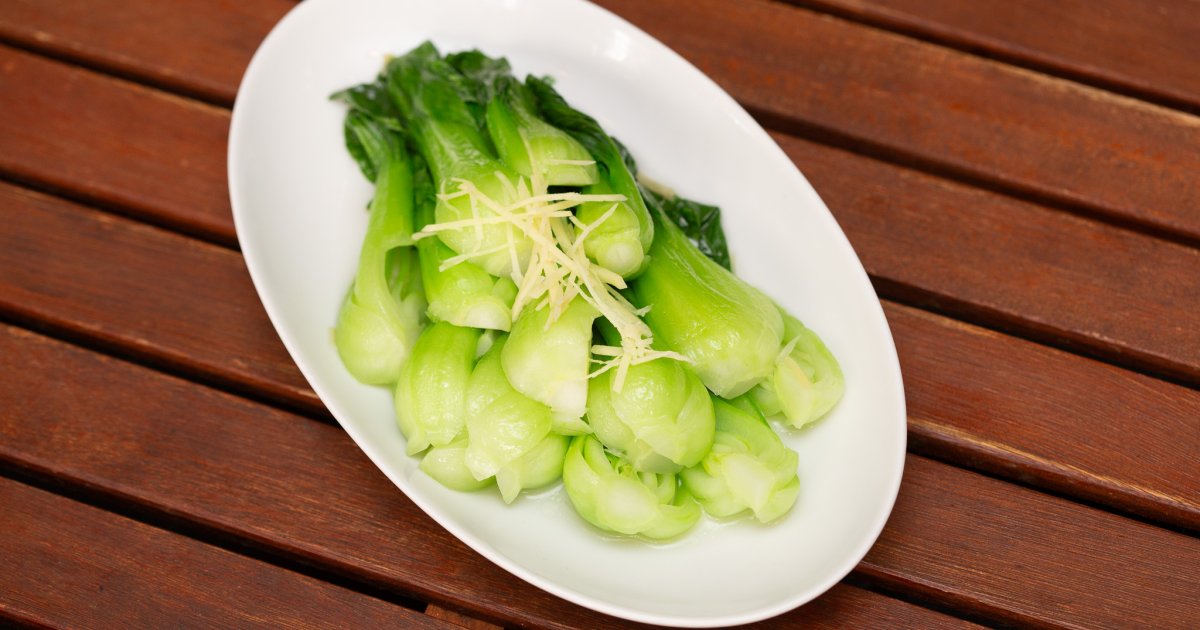
There are dishes that need to prove they are complex. And there are dishes that do not. Mini Pak Choi is the second kind. Ginger, spring onion oil, sea salt. Two minutes. Not one step too many, not one step too few. I cook this dish when I trust the vegetable.
— Wai-Wah Yung
What is Mini Pak Choi?
Mini Pak Choi (小白菜, xiǎo bái cài) is the small, young version of pak choi — more tender, slightly sweeter, with a texture that holds better during steaming than the larger variety. In Cantonese dim sum, the portion is small (approx. 180 g), but the vegetable’s own flavour is present. Full menu name: Dim Sum Mini Pak Choi 小白菜 ⓥ vegan.
Three seasonings beyond the vegetable itself: ginger, house-made spring onion oil, sea salt. No soy sauce. No oyster sauce. No garlic. That is a decision, not a gap.
Two minutes — precision is the craft
Two minutes for Mini Pak Choi is not an estimate. It is the number that comes from years of experience: at this size, this temperature, this steamer. The leaves become soft, the stems keep their bite. One minute less: still too raw. One minute more: the green loses its vitality, the texture turns soft instead of tender.
The precision is the craft. What sounds simple — two minutes of steam — is the result of repetition and attention. That is cooking.
The spring onion oil — a fragrance that cannot be expressed in numbers
The oil in this dish is made in-house. Oil at medium heat, a large amount of spring onions, slowly fried for a long time. The oil absorbs the aromatics of the spring onions — over an hour. What you get is no longer a spring onion flavour. It is something broader, softer, deeper.
You cannot express that in nutritional values. The label says fat. What that number does not show: time. Patience. The temperature curve over an hour. That is the oil that goes on the Pak Choi.
It does not come after the steam — it goes in with it. During steaming, it works into the vegetable together with the ginger. The Pak Choi absorbs the fragrance, not just at the surface.
Three seasonings, four elements
Ginger, spring onion oil, sea salt. Why exactly these three? Because each has a different job and together they leave no gap. Ginger warms and makes the Pak Choi more digestible — the thermal counterpart to the cooling vegetable. The spring onion oil adds depth and binds. The sea salt closes and lifts everything else.
In TCM language: four elements in one dish (Earth, Fire, Wood, Water). This is not a construction — it follows the Cantonese kitchen logic that has known these four flavours together for generations.
Each ingredient and its TCM connection
Mini Pak Choi — Earth element, spleen and stomach
Pak Choi belongs to the Earth element in TCM: mild, cooling, relating to the spleen and stomach meridians. It supports digestion and clears heat. The small variety has a more delicate quality that is easier to digest than full-grown pak choi.
Ginger — Fire element, stomach and warmth
Ginger is the classic warming spice of Chinese cooking: Fire element, pungent, warming, stomach meridian. It is the thermal counterbalance to the cooling Pak Choi — a principle of TCM kitchen logic: cold and warm in balance.
Spring onion oil — Wood element, liver and qi
Spring onions belong to the Wood element: warming, they promote qi flow and stimulate appetite. Slowly extracted in oil, this character works more gently and broadly than in fresh, raw spring onions — but it is there.
Sea salt — Water element, kidney and finish
Salt flavour belongs to the Water element and the kidney in TCM. A small amount — as a quiet closing point. It completes the four-element coverage of this dish and lifts the other three flavours without stepping into the foreground itself.
How it is prepared
- Prepare the Mini Pak Choi. Wash, leave whole, distribute evenly on the steamer insert.
- Add ginger, spring onion oil and sea salt. Everything goes on before steaming — the steam carries the aromatics into the Pak Choi.
- Steam for exactly 2 minutes. No more. Set a timer.
- Serve immediately. Pak Choi cannot wait — it keeps cooking from residual heat if left standing.
A note on health
Two minutes of steam is gentle for leafy vegetables: minimal nutrient loss, no direct heat, no oil in the cooking process. The spring onion oil comes in with the steam — as a carrier of aromatics, not a cooking medium.
Ginger contains gingerols — the compounds responsible for its warming properties. Used in small amounts as here, the effect is subtle but real.
Note: The properties of ingredients described here are based on Traditional Chinese Medicine (TCM) traditions and general nutritional information, and do not constitute medical claims. Please consult a doctor for health concerns.
Frequently asked questions
What is the difference between Mini Pak Choi and regular Pak Choi?
Mini Pak Choi is the young, small version — more tender in texture, slightly sweeter. Full-grown Pak Choi is sturdier and needs longer. For this dim sum dish the small variety is essential: it holds the two-minute steam time without becoming soft.
Why no garlic in this dish?
Garlic would pull the dish in a different direction — more assertive, sharper. The Mini Pak Choi with ginger and spring onion oil has a quieter, rounder quality, more focused on the vegetable itself. Garlic and ginger together would be too much — one had to stay. Li Xiejie chose ginger.
How do I make spring onion oil at home?
Neutral oil at medium heat, spring onions in rough pieces placed in the oil. At least 45 minutes, ideally an hour, at steady medium heat — the spring onions turn golden. Strain the oil. It keeps in the fridge for weeks and pairs well with many steamed vegetables.
More from the Yung Kitchen:
Why Mini Pak Choi is so healthy
Mini Pak Choi (小白菜) is a true cruciferous vegetable – and shares the medically well-documented bioactive compounds of this plant family.
Glucosinolates: Cancer protection through chewing
Pak Choi (Brassica rapa subsp. chinensis) contains the same cancer-protective glucosinolates as broccoli or cabbage. Pioneering work from the University of Minnesota demonstrates that indole-3-carbinol and diindolylmethane – both released when you chew cruciferous vegetables – reliably protect against cancer in laboratory and animal studies by inhibiting carcinogens and blocking tumour initiation.
Vitamin C & secondary metabolites: Double antioxidant protection
A 2025 study by the Chinese Academy of Sciences on bok choy reveals a remarkable interplay: ascorbic acid (vitamin C) biosynthesis simultaneously activates the accumulation of phenolics and flavonoids – both potent antioxidant compounds. Brief steaming largely preserves this system.
Sources (PubMed): Fujioka et al. (2016), Mol Nutr Food Res, PMID 26840393, DOI · Gao et al. (2025), Plant Physiol Biochem, PMID 40441099, DOI
Food Science Background
„These flowering heads are full of glucosinolates, polyphenols, minerals, vitamins and antioxidants.“
— Bernard Lahousse, The Art and Science of Foodpairing (2020)
Pak Choi (小白菜) is a member of the Brassicaceae family — the plant group that Lahousse identifies as uniquely dense in glucosinolates, polyphenols and antioxidants. Our rice wine steaming method (料酒入蒸) maintains the precise temperature and moisture conditions that preserve these compounds. Science and tradition say the same thing.