

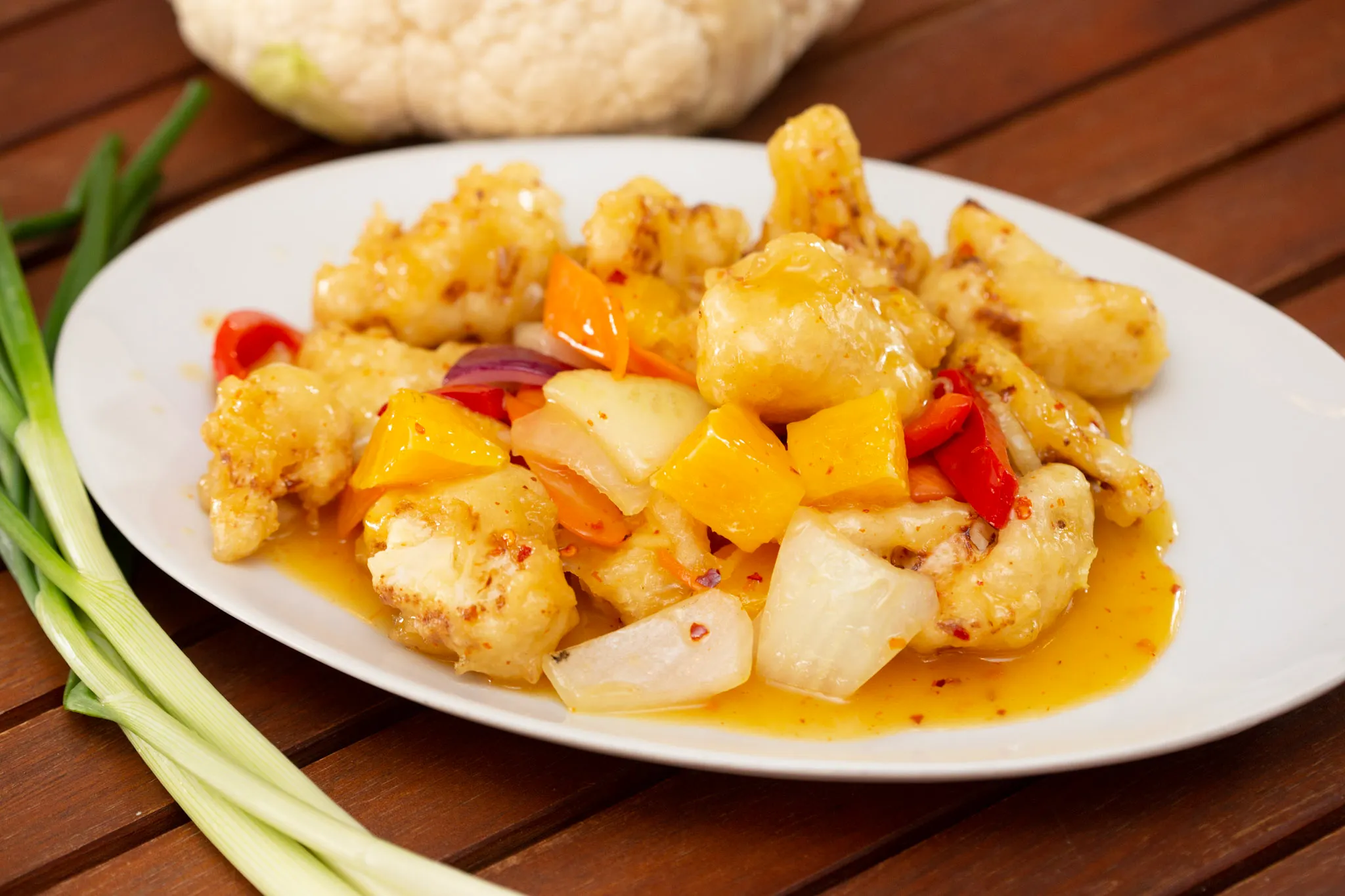
Cauliflower and orange sounds like an experiment. It is not. The acidity of the orange breaks through the mildness of the cauliflower – the same way vinegar works with fat. What results is not a compromise. It is precision in two ingredients.
– Li Xiejie, Head Chef
What is Orange Cauliflower?
香橙耶菜花 (xiang cheng ye cai hua) – fragrant orange cauliflower – is a vegan dim sum dish from the Yung Kitchen. Cauliflower gently cooked and flavoured with fresh orange or orange zest. Fully plant-based, EUR 10.
The cauliflower remains cauliflower – it is not disguised or hidden. The orange provides acidity and fragrance, not sweetness. That is the distinction.
Gentle preparation – preserving nutrients
In Chef Li Xiejie’s version, cauliflower is prepared gently – steamed or briefly cooked at controlled temperatures. The goal: preserve the texture (not mushy), protect the nutrients (vitamin C is heat-sensitive), and not overpower the vegetable’s own character.
The orange enters as acidity, not as a juice marinade. Orange zest contains essential oils – they provide fragrance without liquid. This keeps the cauliflower dry and gives it body.
Each ingredient and its TCM connection
Cauliflower (花耶菜) – Earth energy, strengthens spleen and stomach
Cauliflower is neutral in TCM and belongs to the Earth element. It strengthens spleen and stomach, supports digestion, and has a regulating effect on the body’s centre. Rich in vitamin C, vitamin K and sulforaphane – a glucosinolate with well-documented antioxidant properties from the cruciferous family.
Orange (橙) – dissolves phlegm, promotes qi flow, liver qi
Orange is sour-sweet and cooling in TCM. The acidity stimulates liver qi – a concept describing energy flow and emotional regulation. Orange dissolves phlegm and supports digestion. In modern nutritional science, citrus acid activates digestive enzymes and increases the bioavailability of iron from plant sources.
Combination: sulforaphane from cauliflower + citrus acid = two pathways to better nutrient utilisation. In TCM: Earth element (cauliflower) + Wood element (orange) = digestion and energy flow in alignment.
How it is prepared
- Prepare the cauliflower. Divide into even florets – not too small, or they become mushy during cooking.
- Cook gently. Steam or briefly cook at medium heat until tender-firm. The centre should be cooked through, the texture not softened.
- Prepare the orange. Finely zest the skin, press the juice. Keep separate.
- Add flavour. Toss cauliflower with orange zest and a little juice – just before serving, so the acid does not affect the texture.
- Finish. Fresh herbs or a last grating of orange zest to close.
A note on health
Cauliflower belongs to the cruciferous family – the same family as broccoli and Gai Lan. The glucosinolate sulforaphane is released during chewing and is considered one of the most intensively researched plant antioxidants. Vitamin C is present simultaneously in both cauliflower and orange – and vitamin C demonstrably increases the absorption of iron from plant sources.
Gentle cooking is not a stylistic decision: vitamin C is water-soluble and heat-sensitive. Boiling destroys a substantial portion. Steaming or brief pan-cooking at controlled heat preserves significantly more.
Note: The properties of ingredients described here are based on Traditional Chinese Medicine (TCM) traditions and general nutritional information, and do not constitute medical claims. Please consult a doctor for health concerns.
Frequently asked questions
Why orange and cauliflower together?
Because the acidity of the orange breaks through the natural mildness of the cauliflower. Cauliflower alone tastes neutral – sometimes too neutral. The citrus acidity provides contrast without masking the character of the vegetable. This is the foodpairing principle: two ingredients that complement each other chemically.
Is this dish completely vegan?
Yes. Orange Cauliflower contains only plant-based ingredients. No eggs, no dairy, no animal-based sauces.
What is sulforaphane?
Sulforaphane is a compound from the cruciferous family (cauliflower, broccoli, Gai Lan) released from glucoraphanin during chewing. It is among the most potent plant antioxidants and is intensively studied in cancer prevention research. Gentle preparation preserves more of it than prolonged boiling.
More from the Yung Kitchen:
Why cauliflower and orange are a healthy pair
Sulforaphane from cruciferous vegetables
Cauliflower belongs like broccoli and Gai Lan to the Brassica family. Chewing releases the isothiocyanate sulforaphane from glucoraphanin. A 2023 review in Critical Reviews in Food Science and Nutrition documents chemoprotective activity – sulforaphane regulates cell cycles and inhibits uncontrolled cell growth in laboratory and clinical studies.
Vitamin C: retained through gentle cooking
Both cauliflower and orange are rich in vitamin C. Vitamin C is water-soluble and heat-labile – boiling in water can destroy up to 60%, steaming retains significantly more. Chef Li’s gentle preparation is also a decision for nutrient preservation.