

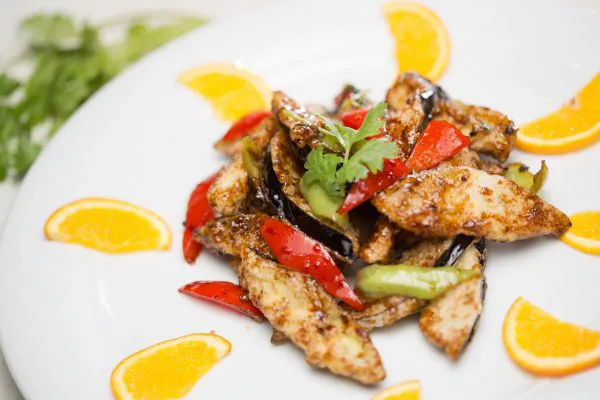
Aubergine responds to heat like no other vegetable. It absorbs everything – the oil, the spice, the fragrance of Sichuan pepper. That is why it must be fried first, before it enters the wok. Not as a shortcut. As preparation. What happens next is decided in ten seconds.
– Li Xiejie, Head Chef
What are Spicy Fragrant Aubergines?
香辣茄子 (xiang la qie zi) – literally fragrant-spicy aubergines – is a Cantonese dim sum dish and one of the most ordered items on our menu. Aubergine lightly coated in flour and fried, then wok-tossed at high heat with red pepper, garlic, chilli and Sichuan pepper, finished with fresh coriander.
No jasmine rice. This dish is complete in itself – as a dim sum portion (approx. 200 g), served without accompaniment. That is a decision, not an omission.
Fry first, then wok – Chef Li Xiejie’s double technique
The first step makes the difference. The aubergine is lightly coated in flour – just a thin layer – and fried in hot oil. Not until cooked through. Only until the outside has structure: a thin, golden layer that protects the vegetable while remaining open to what comes next.
Then comes the second step: high heat, Sichuan pepper into the wok first, until it begins to release its fragrance. Then garlic, chilli, red pepper – and the fried aubergine in. This happens fast. The aubergine holds its shape because of the frying. It absorbs the aromatics without collapsing.
The combination of frying and wok-cooking is not a stylistic preference. It is technically necessary. Aubergine wok-fried directly without pre-frying either collapses or stays dry, unable to absorb anything.
Each ingredient and its TCM connection
Aubergine (茄子) – Yin principle, cools heat, activates blood flow
Aubergine is cooling in TCM and belongs to the Yin principle. It is said to release blood stagnation – a concept describing how blocked energy flows in the body are broken up by specific foods. The purple skin contains nasunin, an anthocyanin regarded as a potent antioxidant, shown in laboratory studies to protect brain cells from oxidative stress.
Sichuan pepper (花椒) – Yang principle, warms the centre
Sichuan pepper is the warming counterbalance to the cooling aubergine. It promotes qi flow, warms the digestive system, and produces the characteristic numbing sensation (麻, ma) – not painful, but a tingling that expands taste perception and triggers endorphin release.
Chilli (辣椒) – Warming, capsaicin effect
Chilli complements the Sichuan pepper: both are warming, both promote circulation. Capsaicin, the active compound in chilli, stimulates the release of endorphins. The interplay of Sichuan pepper (麻) and chilli (辣) creates 麻辣 – a neurological pleasure response acting on two different receptor pathways simultaneously.
Coriander (香菜) – Liver qi, shares aroma compounds with chilli
Coriander is warming in TCM and acts on the liver meridian. It stimulates appetite and lightens heaviness. In aroma research (Lahousse, Foodpairing), coriander and chilli share citrus aroma compounds – not coincidental on the plate, but chemical kinship.
Red pepper (红椒) – Vitamin C, antioxidants, warmth
Red pepper has the highest vitamin C content among the vegetables used and provides lycopene along with additional antioxidants. Warming in TCM, it supports the centre. It gives the dish colour, sweetness and depth – a counterpoint to the heat of chilli and Sichuan pepper.
TCM principle: aubergine (Yin/cooling) + Sichuan pepper/chilli/garlic (Yang/warming) = deliberate balance. The heat complements the coolness. This is not contradiction, it is design.
How it is prepared
- Prepare the aubergine. Cut into strips, dust lightly with flour – a thin coat only. Shake off excess.
- Fry. Fry in hot oil until golden. Not fully cooked through – the outside gets structure, the inside stays soft. Drain and set aside.
- Toast the Sichuan pepper. Into the wok at high heat – briefly, until the fragrance rises. That is the moment.
- Add aromatics and vegetables. Garlic, chilli, red pepper, red onion – stir-fry briefly at high heat, then add the fried aubergine and toss together.
- Coriander at the end. Fresh coriander goes on after the heat is off – placed on the finished dish. The warmth is enough to release its fragrance. Cooking would destroy it.
A note on health
Aubergine has a low caloric density and contains nasunin in the skin – one of the most potent plant antioxidants from the anthocyanin group. Capsaicin from chilli has been linked in several studies to promoting endorphin release. Red pepper is one of the most nutrient-dense vegetables in terms of vitamin C.
Frying adds oil – that is the trade-off of this technique, and also why the aubergine does not absorb further aromatics beyond what is intended. The portion (approx. 200 g) is a dim sum dish, not a main course.
Note: The properties of ingredients described here are based on Traditional Chinese Medicine (TCM) traditions and general nutritional information, and do not constitute medical claims. Please consult a doctor for health concerns.
Frequently asked questions
Is this dish fully vegan?
Yes. The dish contains only vegetables, spices and flour – no animal products. The flour is wheat flour. If you have a gluten intolerance, please ask the team before ordering.
How spicy is it really?
It is spicy – that is not an understatement. Sichuan pepper creates numbness (麻), chilli creates heat (辣). Together that is 麻辣 – intense but not overwhelming. Guests who cannot tolerate heat should choose a different dish. Those who enjoy spice get a precisely balanced experience here.
Why no rice?
This is Chef Li Xiejie’s decision. The dish is a dim sum portion – self-contained, complete in itself. Rice would dilute the intensity of the flavours. The spice, the fragrance of the coriander and the texture of the aubergine come through better without accompaniment.
More from the Yung Kitchen:
What research says about aubergine and capsaicin
Nasunin: Anthocyanin of the aubergine skin
The purple pigment in aubergine skin contains nasunin, an anthocyanin from the polyphenol group. Studies on brain cells show that nasunin protects cell membranes from lipid peroxidation – a mechanism associated with the prevention of neurodegenerative processes. Aubergine is regarded as one of the few vegetables with documented neuroprotective activity at the cellular level.
Capsaicin and the endorphin system
Capsaicin, the active compound in chilli, binds to TRPV1 receptors and triggers a heat response – the brain responds with endorphin release. In combination with Sichuan pepper, the 麻辣 double effect emerges: numbness and heat simultaneously, both with positive neurological feedback.