

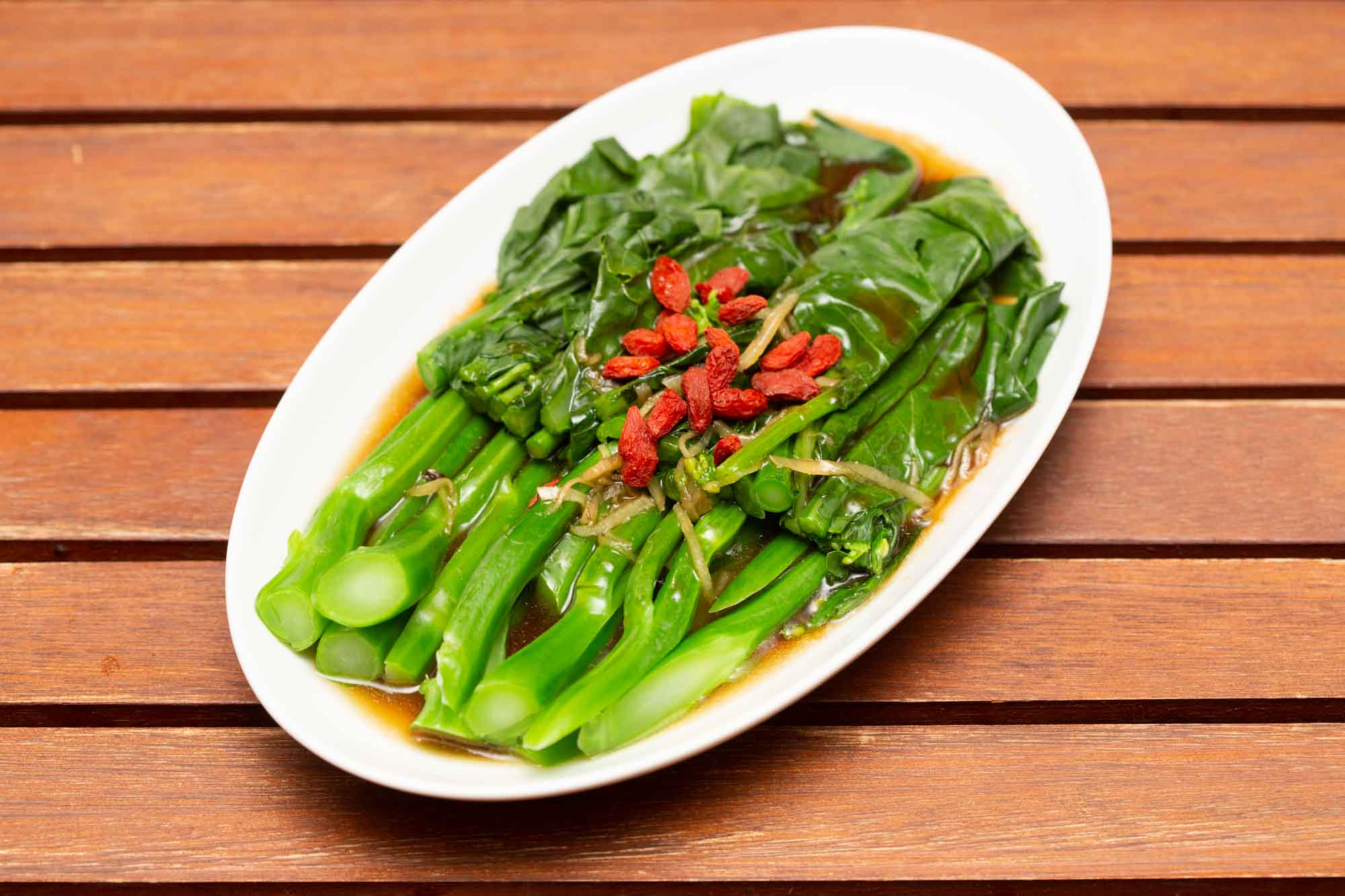
Gai Lan is the most honest vegetable in Cantonese cooking. Slightly bitter, dark green, and it tolerates no distraction. No ginger — that is not an omission, it is a decision. Cooking wine during steaming, spring onion oil at the end, mushroom sauce to finish. Three steps. Three minutes. That is everything.
— Wai-Wah Yung
What is Gai Lan?
Gai Lan (芥蘭, jiè lán) is Chinese broccoli — a brassica that is little known in Germany but central to Cantonese cooking. Wide dark green leaves, thicker stems, and a flavour that is distinctly bitter — not unpleasant, but characteristic. In Hong Kong and Guangzhou, Gai Lan with oyster sauce is a standard dish. Ours is fully vegan — with mushroom sauce instead of oyster sauce.
Full menu name: Dim Sum Portion Gai Lan 蒸芥蘭 ⓥ vegan.
Cooking wine in the steam — an almost forgotten technique
The cooking wine does not come after steaming. It goes in when the vegetable enters the steamer. That is the decisive difference. The steam carries the wine through the Gai Lan as it cooks. What happens: the natural bitterness of the leaves is softened, and simultaneously the sweetness of the vegetable comes forward — a sweetness that would otherwise stay hidden.
This is not a marinade. It is not a sauce. The wine is part of the steam. In three minutes it works into the vegetable — subtle, not intrusive, and fully cooked off when the dish is ready.
Very few Chinese restaurants in Germany prepare vegetables this way. This is the craft behind this dish — invisible when you eat it, but present in the taste.
The spring onion oil — a fragrance that cannot be expressed in numbers
The oil that finishes this dish is not something you buy. It is made in-house: oil at medium heat, a large amount of spring onions, slowly fried for a long time. The oil absorbs the aromatics of the spring onions — for an hour, sometimes longer. What remains cannot be found in any nutritional table.
It is no longer just fat. It is time. It is the result of patience in the kitchen, and that patience has a taste. The industrial equivalent does not exist — this oil cannot be shortcut.
It is the last element on the Gai Lan, and it rounds the dish. The bitterness of the leaves, the wine note from the steam, and then this broad, soft spring onion fragrance. Three layers.
Why no ginger
This is Li Xiejie’s decision — our head chef. Ginger is standard in many Chinese vegetable dishes. Not here. Gai Lan has a flavour that ginger would overwhelm: that slight, characteristic bitterness. That is the most valuable thing about this vegetable. Ginger and Gai Lan do not belong together — not because there is a rule, but because ginger erases the substance of the dish.
No ginger is not a gap. It is a position.
Each ingredient and its TCM connection
Gai Lan — Fire element, heart and detoxification
Bitter flavour belongs to the Fire element and the heart meridian in TCM. Gai Lan is cooling, detoxifying, and supports digestion. The bitterness is not incidental — it has a function, in the kitchen and in the TCM framework.
Spring onion oil — Wood element, liver and appetite
Spring onions belong to the Wood element: warming, pungent, liver meridian. They stimulate appetite and promote qi flow. Slowly extracted in oil, the spring onion retains these properties — in a gentler, broader form than freshly cut spring onions.
LKK Vegan Mushroom Sauce — Earth element, spleen and stomach
Lee Kum Kee’s vegan mushroom sauce contains no oysters — it is made from mushrooms. In TCM, the sweet-umami flavour belongs to the Earth element, relating to spleen and stomach. The sauce completes the dish and adds depth without masking the bitterness of the Gai Lan.
Note: bitter (Gai Lan) + pungent (spring onion) + sweet-umami (mushroom sauce) — three flavour layers, three TCM elements in one dish.
How it is prepared
- Prepare the Gai Lan. Wash, trim hard stem ends if needed. Place whole on the steamer insert.
- Add cooking wine and spring onion oil. Both go on the vegetable before steaming — not after. The steam carries them into the Gai Lan.
- Steam for exactly 3 minutes. Stems become tender, leaves keep colour and texture.
- Drizzle LKK Vegan Mushroom Sauce. After steaming, evenly over the vegetable — the final step.
A note on health
Gai Lan is rich in vitamins C and K as well as calcium. Steaming preserves these better than boiling. Three minutes is enough to make the stems tender without stressing the nutrients.
The vegan mushroom sauce delivers umami without animal products — a conscious choice for a fully plant-based dish with flavour depth.
Note: The properties of ingredients described here are based on Traditional Chinese Medicine (TCM) traditions and general nutritional information, and do not constitute medical claims. Please consult a doctor for health concerns.
Frequently asked questions
What is the difference between Gai Lan and regular broccoli?
Gai Lan (芥蘭) is Chinese broccoli — related but a different plant. Wider darker leaves, thicker stems, and a characteristically bitter-herbal flavour. Regular broccoli tastes milder. In Cantonese cooking, Gai Lan is the classic dim sum vegetable — broccoli is not a substitute.
Why vegan mushroom sauce instead of oyster sauce?
The classic Cantonese version uses oyster sauce. We use LKK Vegan Mushroom Sauce so the dish stays fully plant-based. Mushroom sauce has a similar deep umami character — from mushrooms, without seafood. For vegan or vegetarian guests, this is not a compromise, it is the intentional version.
Where can I find Gai Lan to cook at home?
In Asian supermarkets in Frankfurt and most major German cities — fresh or frozen. The spring onion oil takes time (at least 45 minutes at medium heat with a generous amount of spring onions) but is the most important step when recreating this at home.
More from the Yung Kitchen:
Why Gai Lan is so healthy
Gai Lan (芥蘭, also called Chinese broccoli) belongs to the cruciferous family – a group of vegetables that cancer research has studied intensively for decades.
Sulforaphane: Cruciferous power against cell damage
Gai Lan and broccoli share the same botanical family (Brassica oleracea) and the same phytochemical fingerprint. A 2023 review in Critical Reviews in Food Science and Nutrition demonstrates that chewing releases sulforaphane from the glucosinolate glucoraphanin. Sulforaphane regulates cell cycles, inhibits uncontrolled cell growth, and shows strong antioxidant activity – with chemoprotective effects confirmed for multiple cancer types in lab and clinical studies.
Indole-3-carbinol: Evidence from human studies
A 2025 review in Annual Review of Nutrition (Oregon State University) summarises recent human data: sulforaphane and indole-3-carbinol from cruciferous vegetables such as Gai Lan demonstrably reduce breast cancer risk and improve treatment outcomes – with interactions with individual gut microbiome profiles making this a promising complementary approach alongside standard care.
Sources (PubMed): Gasmi et al. (2023), Crit Rev Food Sci Nutr, PMID 37129118, DOI · Ho et al. (2025), Annu Rev Nutr, PMID 40841315, DOI