

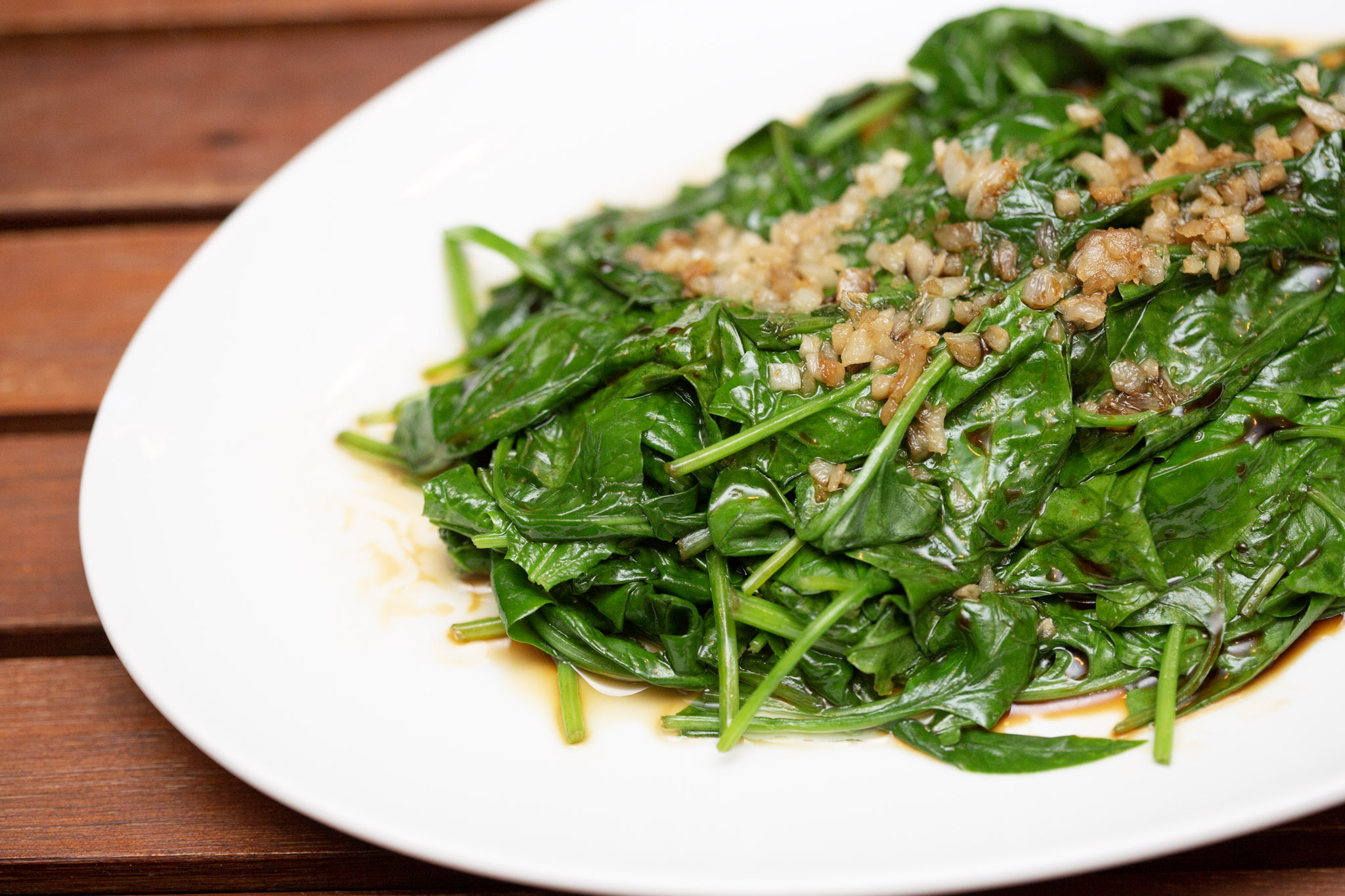
During my recovery, I learned what food can actually do. This steamed spinach is one of the dishes I have been cooking ever since — not because it is elaborate, but because it works. One minute of steam, fresh garlic, hot oil. And that one moment when the oil hits the garlic.
— Wai-Wah Yung
What is Suan Rong Bocai?
Suan Rong Bocai (蒜蓉菠菜) is a Cantonese steamed vegetable dish from our dim sum menu — fully vegan and technically one of the simplest things we cook. Full name on the menu: Dim Sum Steamed Spinach 蒜蓉菠菜 ⓥ vegan.
Spinach steamed for one minute. Fresh minced garlic on top. Hot oil poured over. Goji berries. A few drops of seasoning sauce. That is everything. But the sequence is not negotiable — and the reason lies in the technique.
Pō yóu — the hot oil is what this dish is about
Pō yóu (泼油) means pouring hot oil over freshly cut garlic. What happens next takes a second — but that is the reason this dish smells the way it does. The sizzle when the oil hits is the most honest sound in this kitchen.
The difference between freshly minced and pre-fried garlic is decisive. Fresh garlic activated by hot oil releases a bright, lively fragrance. Pre-fried garlic has already spent that. Allicin — the aromatic compound released when garlic is chopped — is heat-sensitive. One second of hot oil: active. Five minutes in the pan: gone.
So: cut the garlic fresh, just before serving. The oil has to be genuinely hot — not warm, not medium. Then the moment works.
Each ingredient and its TCM connection
Spinach — Wood element, liver and blood
In TCM, spinach belongs to the Wood element. It has a cooling nature, nourishes liver blood, and relates to the liver and large intestine meridians. Dark green leaves, high iron content — TCM and modern nutritional science arrive at similar conclusions here.
Fresh garlic — Wood element, liver and detoxification
Garlic is also Wood element: warming, pungent, liver meridian. In TCM it is considered detoxifying and circulatory. Allicin, formed when garlic is chopped, is the basis for both properties — the culinary and the traditionally medicinal one.
Goji berries — Wood element, liver-yin and eyes
Goji berries (枸杞, gǒuqǐ) nourish liver-yin and kidney energy in TCM, with a known connection to eyesight. Zeaxanthin — the carotenoid concentrated in the retinal macula — is particularly abundant in goji. We do not add them to the steam or the heat: cold, last, on the finished dish. That way all nutrients are fully preserved.
Seasoning sauce — Water element, salt flavour, quiet finish
A few drops at the end. Salt flavour belongs to the Water element and the kidney in TCM — a small amount as a final touch closes the dish without dominating it. Anyone who knows this type of seasoning from European cooking will find it works differently in this context.
Note: all three main ingredients — spinach, garlic, goji — belong to the Wood element. This is not a coincidence. It is a dish with a single focus: liver and blood.
How it is prepared
- Steam the spinach. Wash fresh spinach, lay whole leaves in the steamer — exactly 1 minute. No more. With tender spinach, this is the line between just right and overcooked.
- Garlic on top. Remove spinach from steamer. Distribute freshly minced garlic evenly over the hot spinach — freshly cut, not pre-fried.
- Pour the hot oil (Pō yóu). Heat oil in a small pan until it just begins to smoke. Pour immediately over the garlic. The sizzle is the signal: the temperature is right, the aromas open up.
- Scatter the goji berries. Cold, as the last layer on the finished dish — not before, not heated. This preserves zeaxanthin and all other heat-sensitive nutrients completely.
- Seasoning sauce to finish. A few drops, evenly distributed — sparse, as a quiet closing note.
A note on health
Steaming is one of the gentlest cooking methods for leafy vegetables: no direct fat, no overcooking, minimal nutrient loss. One minute for tender spinach is an experience number, not an estimate.
Hot oil activates the allicin in the garlic without destroying it — the key is brief, intense heat contact. Adding goji berries cold preserves zeaxanthin and other heat-sensitive compounds. These are not theories: this is good cooking that happens to also be nutrient-conscious.
Note: The properties of ingredients described here are based on Traditional Chinese Medicine (TCM) traditions and general nutritional information, and do not constitute medical claims. Please consult a doctor for health concerns.
Frequently asked questions
Is this dish fully vegan?
Yes. Spinach, fresh garlic, goji berries, oil and seasoning sauce — all ingredients are plant-based. If you need gluten-free: the standard seasoning sauce contains wheat. Leave it out or replace with tamari.
Why are the goji berries added cold at the end?
Zeaxanthin — the carotenoid in goji berries associated with retinal health — is heat-sensitive. Cooking goji berries destroys part of these compounds. Added cold on the finished dish, all nutrients remain fully intact. That is the traditional way — and simultaneously the most nutrient-preserving one.
Can I make this at home?
Yes, with a steamer or a pot with a sieve insert. The one essential condition: the oil has to be genuinely hot before it hits the garlic. Lukewarm does not work for pō yóu — the aroma activation needs that brief, intense heat shock. Cut the garlic fresh, do not pre-fry it.
Where can I find this dish on the menu?
The steamed spinach is on our dim sum menu as a vegan side dish. Available year-round.
More from the Yung Kitchen:
Why steamed spinach is so healthy
Spinach is far more than a green side dish – nutritional science reveals what this unassuming leafy vegetable really delivers.
Nitrate: A natural blood pressure regulator
Spinach ranks among the most nitrate-rich vegetables. Researchers at the University of Exeter showed that regular consumption of nitrate-rich leafy greens like spinach boosts the body’s nitric oxide (NO) availability – lowering blood pressure, improving tissue blood flow, and potentially enhancing cognitive performance. No supplement needed: a single portion of spinach is enough.
Lutein & zeaxanthin: Protection for your eyes
Spinach is one of the richest dietary sources of lutein and zeaxanthin – the only carotenoids that accumulate directly in the macular region of the retina. A 2022 review in Nutrients confirms that regular intake of lutein-rich foods can demonstrably slow the progression of age-related macular degeneration (AMD) and reduce cataract risk.
Sources (PubMed): McDonagh et al. (2018), Eur J Sport Sci, PMID 29529987, DOI · Mrowicka et al. (2022), Nutrients, PMID 35215476, DOI
Food Science Background
„In China, sliced fresh ginger, garlic and spring onions are the building blocks of many Cantonese, Jiang nan and Sichuan dishes, often cooked rapidly at the start of a recipe to flavour the oil before adding the rest of the ingredients.“
— Bernard Lahousse, The Art and Science of Foodpairing (2020)
This is exactly the science behind our Pō yóu technique (泼油): pouring hot oil over garlic releases the sulphurous aroma compounds that Lahousse identifies as the molecular foundation of Cantonese cooking. What generations of Cantonese cooks have known intuitively, foodpairing science now confirms.