

„Soybean paste is not a seasoning you measure — it is the character of the dish. Too little and you taste nothing. Too much and you taste only the paste. The mushrooms need room to speak.“
— Wai-Wah Yung
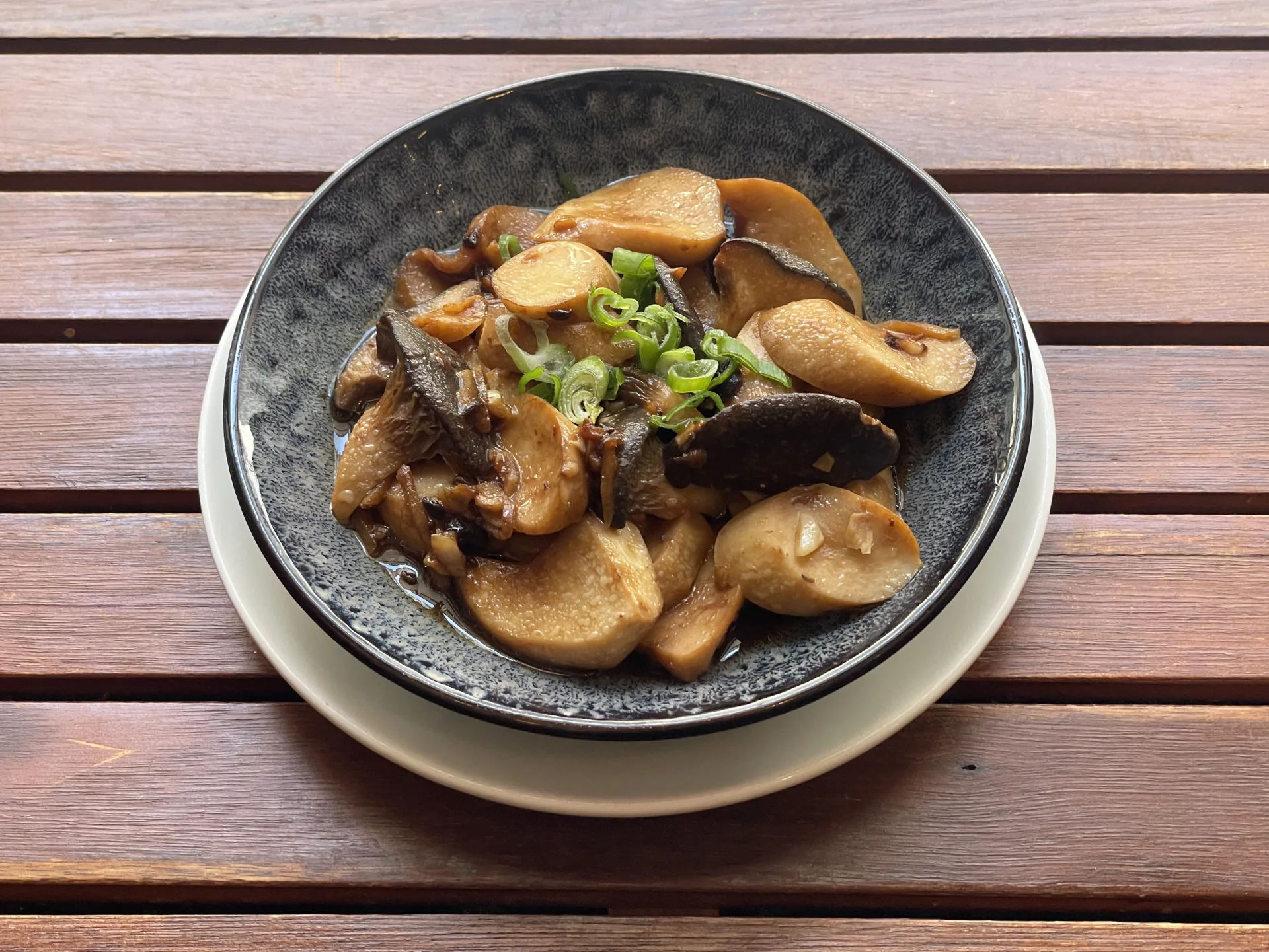
What is 豆瓣醬蒸雞髀菇 — Steamed King Oyster Mushrooms with Soybean Paste?
King oyster mushrooms (Pleurotus eryngii, Chinese 杏鮑菇 or 雞髀菇) are among the meatiest edible mushrooms. Their firm, almost elastic texture holds up exceptionally well to steaming. In this dish, they are combined with shiitake mushrooms and steamed in a savoury soybean sauce (豆瓣醬, dòubàn jiàng) — a method that preserves the full depth of the mushroom flavour while binding it with the fermented umami of the paste.
The name 雞髀菇 (jī bì gū) refers to the king oyster mushroom’s shape — it was thought to resemble a chicken drumstick (雞髀, jī bì). The dish is fully vegan, but contains soya and wheat (gluten) from the soybean paste.
Spring onions as garnish add fresh sharpness and colour — they are placed after steaming, not cooked with the dish.
The Technique — Steaming with Sauce (清蒸加醬 / qīng zhēng jiā jiàng)
Steaming is the technique in Cantonese cooking where you trust the ingredient the most. No oil, no wok heat, no stirring. The steam does the work — and the soybean paste blends with the liquid the mushrooms release during cooking, forming a sauce that needs no added starch.
The cut matters: mushrooms need to be sliced at an even thickness so they cook uniformly. The sauce goes on in a thin, even layer — not a flood. Eight to ten minutes of steady steam. The result is a dish where mushroom and paste have genuinely merged.
You cannot express that in nutritional values.
The Ingredients
King Oyster Mushrooms (杏鮑菇, Pleurotus eryngii)
King oyster mushrooms have an exceptional texture — firm, slightly springy, close to meat. They hold this texture when steamed, unlike most other edible mushrooms. Their flavour is mild and nutty, an ideal base for the bold soybean paste. In Traditional Chinese Medicine, they are associated with the Earth element and the Spleen-Stomach meridian, considered nourishing and easy to digest.
Shiitake Mushrooms (香菇, Lentinula edodes)
Shiitake bring depth and umami. They contain lentinan, a beta-glucan studied extensively in food science. In Cantonese cooking, shiitake are never a minor garnish — here they are equal partners to the king oyster mushroom. Their softer texture when steamed deliberately contrasts with the firmness of the king oyster: two textures, one dish.
Soybean Paste (豆瓣醬, dòubàn jiàng)
Soybean paste is a fermented soya product with a deep, salty, mildly savoury character. The paste used here is mild — without chilli — in the style closer to Korean doenjang: concentrated, complex, not spicy. This is not to be confused with Sichuan doubanjiang, which contains chilli and carries heat. Contains soya and wheat (gluten) — both declarable allergens under EU food labelling law.
Spring Onions (葱)
Garnish only, not cooked into the dish. The green part, thinly sliced, goes on after steaming. Fresh contrast — mild heat, visual brightness against the deep brown of the sauce.
Preparation
- Prepare the mushrooms. Slice king oyster mushrooms into rounds about 1.5 cm thick — even cuts so everything cooks at the same time. Halve or quarter the shiitake depending on size.
- Mix the sauce. Combine soybean paste with a splash of water and a teaspoon of sesame oil until smooth and spreadable.
- Arrange and coat. Place mushrooms on a ceramic plate or in a bamboo basket. Spread the sauce evenly and thinly over the mushrooms — do not overload.
- Steam. Steam over steady heat for 8–10 minutes, until the mushrooms have released their liquid and the sauce has thickened naturally.
- Garnish and serve. Scatter spring onion rings immediately after removing from the steamer. Serve hot.
Allergens
Contains: Soya, Wheat (contains gluten) — from the soybean paste. The dish is otherwise free from the other 12 declarable allergens under EU food information law (FIC/LMIV).
Not spicy: The soybean paste used contains no chilli — it is mild and savoury.
Vegan: All ingredients are plant-based.
Note: The traditional properties of the ingredients described here are based on Traditional Chinese Medicine (TCM) and general nutritional references. They do not constitute medical or health claims. Please consult a doctor for any health concerns.
Frequently Asked Questions
Is this dish spicy?
No. The soybean paste (豆瓣醬) used is a mild, fermented paste without chilli — in the style of Korean doenjang, not Sichuan doubanjiang. There is no heat in this dish.
Does this dish contain gluten?
Yes. The soybean paste contains wheat and therefore gluten. The dish is not suitable for people who need to avoid gluten for medical reasons (e.g. coeliac disease). Soya is also present and declarable under EU food labelling law.
What is the difference between king oyster mushrooms and regular oyster mushrooms?
King oyster mushrooms (Pleurotus eryngii, 杏鮑菇) are significantly larger and firmer than oyster mushrooms (Pleurotus ostreatus). Their texture is dense and slightly springy — they hold their shape when steamed and do not become mushy. Their flavour is milder and nuttier than the oyster mushroom.
Is this on the menu at China Restaurant Yung?
Yes, this dish is part of the Yung Kitchen selection and is available as a dim sum or vegan side. Check our menu or ask us directly at the restaurant — we are happy to tell you what is available on any given day.
Discover more: